
Decisions, not questions
I answered about 1,500 decisions from my agents in four weeks. Most of the time I tapped the recommendation. Here's what makes one quick to answer.
Since October 11 I've answered about 1,500 decisions from my agents, across all my projects, client work included. In 90% of them I took what the agent recommended. For the rest I picked another option or wrote my own answer.
That sounds like a lot of interruptions. It mostly isn't, and the reason is the shape the question arrives in.
The question at the bottom of the chat
Any agent doing real work for you will eventually need a call from you. In most chat tools that call arrives as a line at the end of a long reply: "Which would you prefer?" To answer it you scroll up, rebuild the background in your head, and type something. If you were busy, the question scrolls away and the work stops halfway. Nobody notices until you go looking.
I was losing work exactly that way. I had many things running at once, and every so often I'd forget a chat with real work in it. The fix we wrote down when we built decisions was to pull the question out of the conversation and hand it over ready to decide, with the background, the options and the agent's recommendation in one place. Once it's decided, it leaves my view. We went for many self-contained briefs rather than one queue, because order was never the issue. Each question had simply arrived without its context. And the button itself carries the choice out, so I never have to type "yes, go ahead" for a click to count.
What lands on my phone
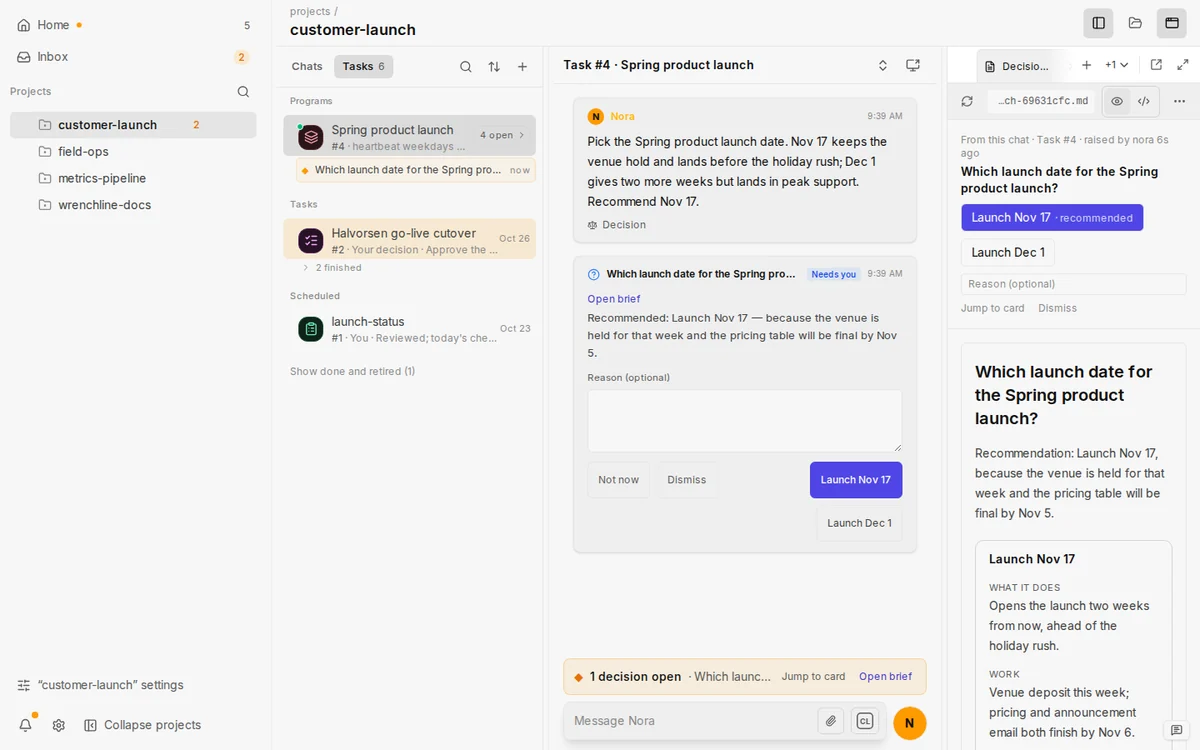
In Lowkey, a choice the work can't move without arrives as a short brief that opens beside the chat. One line for the question. The agent's recommendation and a sentence on why. A small table of the options, with the work involved and the main risk of each. Then the options as buttons, worded as what they'll do: "Publish now", "Hold".
I read the recommendation, glance at the table, and tap. If I want something different I type it, and the agent carries on from what I wrote, though approvals to send something or act on my behalf still need the button. The answer goes straight back to the agent that asked, and the decision leaves my Inbox.
I do think about that 90%, because it cuts both ways. It means the briefs are usually right, so answering is quick. It also means the recommendation carries a lot of weight, and a lazy one would get waved through. The table is what keeps me honest. When the risk column mentions something I hadn't considered, I slow down. When every option looks the same, I send it back.
Saying yes once
Some approvals keep coming back: publish the docs once I've checked them, reply to an everyday request in the usual way. When I tell an agent "just do those without asking", it opens one more decision that spells out exactly what the standing answer would cover, and I approve that. From then on agents act under it and record each time they did. My Work log shows about 1,600 of those actions, each one a question nobody had to ask me, tagged so I can find them on Home. I can also see what each standing answer covers, and change or withdraw it later.
A wiki page or a note about what I decided last time never counts as permission. Only my answer does.
Why this matters more for you than for me
If you pay for ChatGPT or Claude and want it to book, send or file things for you, the worry is that it will act without asking. Agents in Lowkey are built to ask before anything that leaves your box, like sending an email: a tap on a decision, or a standing answer you approved earlier. You see the brief, the risk and a button before anything goes out.
In a shared project, a decision goes to the person who can make it. Whoever handles the money gets the money question in their Inbox. Nobody else's Inbox fills up with it, and the brief stays in the shared chat for anyone who wants the background.
And if you want agents running on their own while you're away, standing answers are the middle ground between "ask me every time" and "never ask". You approve a class of action once and keep a record of every use. Start narrow, watch the log for a week, then widen it if it's behaving.
Trying it
- "Ask me before you book anything over $200." The next time it comes up, you'll get a decision.
- "What's waiting on me?" Or open Inbox to see every open decision.
- "You can publish the weekly report without asking once I've seen the first one." Then approve the standing answer it proposes.