
Let a program run your recurring work
How I keep Lowkey's docs current without thinking about it: one program, a quiet check every morning, and a daily review that tells me in one line what needs me.
Every morning at 7:23, a small script checks Lowkey's public docs against the latest release of the product and against the releases customers are actually on. (Each customer has a private server; we call it a box.) Most mornings it finds nothing, and when it finds nothing it says nothing. No agent wakes up and nothing reaches my phone. The last five mornings went that way.
At 8:41 an agent reads over the whole docs effort. It re-reads the plan, looks at each task, and leaves me one line about what needs me. Usually that line says nothing does.
That pair, a quiet check and a short review, is what Lowkey calls a program with a heartbeat. Of everything in the product, it's the part I'd least like to give up.
Where the work used to go missing
Some work never finishes. A website that has to keep up with a product. A house move. A client you look after every week. Before programs I handled that kind of work the way most people do: a chat, then another chat, and pins on the important ones. A month in, the pins were a museum. The plan lived in one thread and the latest news in another, and whatever I meant to chase on Friday was three screens up somewhere I hadn't opened since. Nothing failed outright. It just went quiet, and nothing noticed.
When we looked at the pinned chats that did carry real work, they all had the same shape: a standing chat, a plan, a status page, and the actual work spun off somewhere else. Programs are that shape, built in. You make one on purpose, give it a plan, and an agent reviews it on a schedule.
Two rules came with it. Every open task carries a date it will come back on: a chase date if it's waiting on someone, the expected date if it's waiting on an event. Nothing sits undated. And the clock only handles dates. Deciding what deserves your attention is the agent's job, done in a chat you can read.
Inside the docs program
The docs program started on October 19, the day I moved the docs site into Lowkey's business project. It holds eight tasks so far: the daily check, a weekly look at how the pages render, a rotating content review, a restyle, a page we cut when we went hosted-only, and the three tasks behind this blog. Four are done. When a task's date comes round, Lowkey wakes it in its own chat with its current state attached, so the Monday visual check happens whether or not I remember it.
What it catches is mostly dull, which suits me. A page describing a feature no customer has yet gets held back until their boxes catch up. A docs change waits for my go-ahead before it goes live, and the program keeps a running note of what's held and why. When I open its chat, the first line tells me where things stand.
It isn't foolproof. A quiet check is only as good as its script, and I learned that one morning when the check's download of the latest Lowkey code failed. It carried on with the copy it already had, and nothing in the check flagged the failure. The agent happened to notice in passing, and the heartbeat an hour later dug in: on any other day, that failure would have stayed silent. The check now says so out loud when it can't get a fresh copy. If you schedule something to stay quiet, make sure quiet still means fine.
Across all my projects, client work included, I now have 67 programs. 23 of them have a heartbeat, and between them they hold about 1,600 tasks. On a given day I don't look at most of them, which is the whole idea.
The same idea, away from a docs site
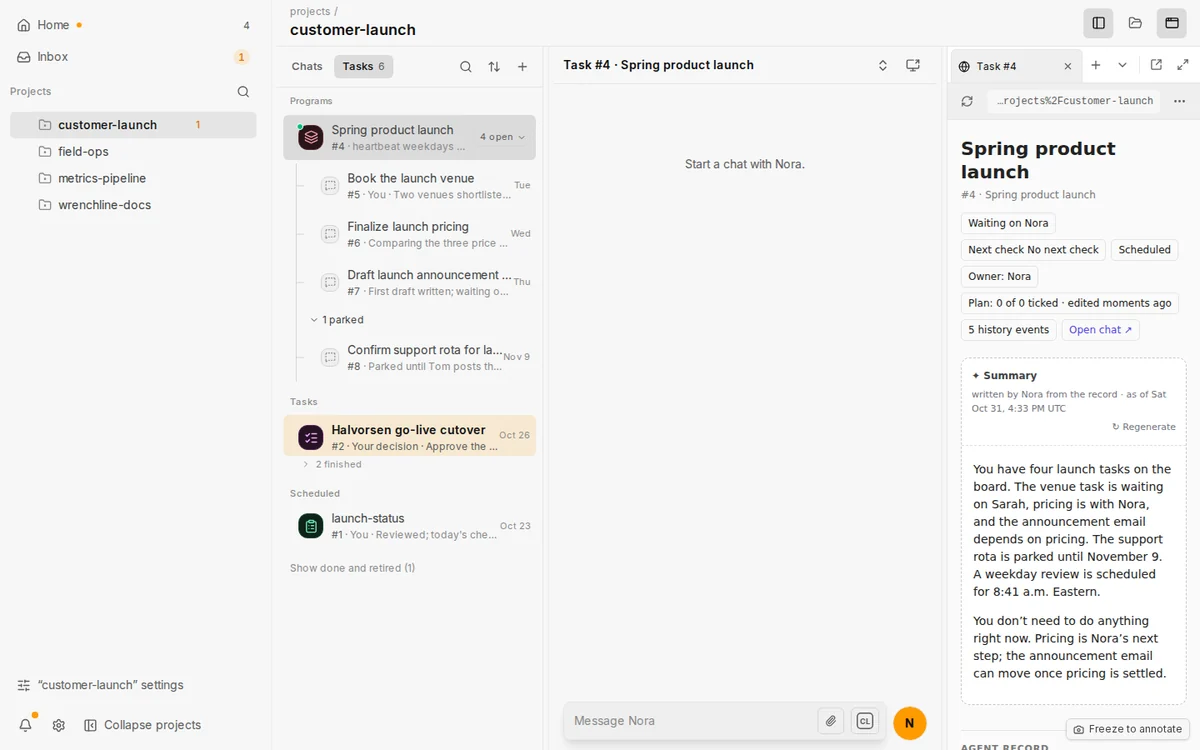
Picture a move. The movers, the lease, the school forms, the utilities: four tasks with four dates. Put them in a program with a Monday review and you stop carrying the list in your head. Each task comes back on its own date, and the heartbeat tells you which one slipped. If you already pay for ChatGPT or Claude, this is the step past "it told me what to do": it keeps track of the doing.
A household or a small team gets one more thing out of it. A launch, a renovation, a parent's paperwork: everyone sees one plan and one chat, and the heartbeat's line about what needs a person lands where everyone can read it. Nobody has to be the one who remembers to ask how it's going.
If you like to tinker, give each of your morning scripts a task with a schedule and group them in a program. They run quietly and cost nothing when they pass. When one fails, the agent wakes in that task's chat with the evidence and works out what happened, and the heartbeat keeps a fix that's waiting on you from being forgotten.
Trying it
There's nothing to configure. You ask:
- "Group my move tasks into a program and review them every Monday morning."
- "Chase the landlord about the deposit if they haven't replied by Friday."
- "Every weekday at 7, check the shared folder for new invoices and only tell me if one is overdue."
A program only exists when you ask for one, and only you can close it.