
Workers: hand off the reading, keep the conversation
The agent I talk to doesn't do all the grinding itself. It hands self-contained jobs to helpers on other models, and every one of them leaves a chat I can open.
For this series I wanted to tell why each feature was built the way it was. That reasoning lives in Lowkey's design notes: close to a thousand files, going back months. I asked my agent to dig it out. If it had read them all inside our conversation, everything else we'd talked about would have been buried under them.
So it didn't. It handed the job to a worker, a helper running on a different model, with a short brief: find the original problem behind each feature, quote the founding ideas, and flag anything I shouldn't say publicly because a feature hasn't shipped or a detail is private. A few minutes later a two-page note came back and woke my agent to carry on.
The note also corrected me. I'd assumed workers were built to keep the main chat uncluttered. According to the notes, the first reason was that I didn't want any hidden helpers, and the worker told me so.
One chat trying to do everything
Ask a single AI chat to read forty documents, compare three vendors and then write you a summary, and you watch it slow down and lose the thread. Everything it read is still sitting in the conversation, crowding out what you actually said. The usual workaround is to open five chats yourself and copy results between them. That makes you the coordinator, which is the job you were hoping to hand off.
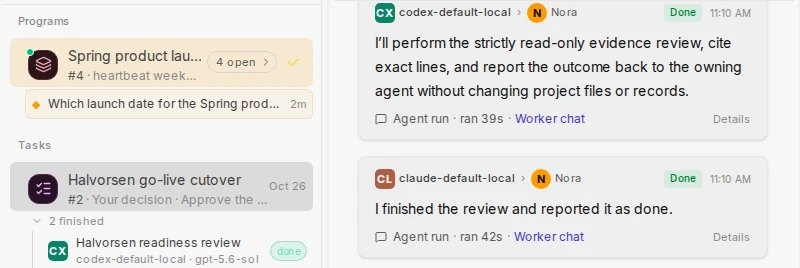
The goal we wrote down early on was that I'd talk to a few agents and they'd handle the helpers behind the scenes. The other half mattered just as much: nothing invisible. Every helper's work is a chat I can open to see exactly what it did. My agent treats a worker as a job. It wants a result it can react to on its next turn, and that result always comes back to whoever asked, in the chat where the work started.
Choosing the helper took some learning. Early on, which model got a job was close to arbitrary. Now each kind of worker carries a plain description of what it's good at, and the agent picks by that.
Twelve days of it
In the business project where I run Lowkey's brand, docs and site, agents started 25 workers in four weeks, on five different models: competitor pricing research, a website audit, a landing-page rewrite, the research behind this blog. Twenty-two finished. Three failed: two because the model's service rejected an expired sign-in that evening, and one at setup, which was rerun. I didn't check on any of them. As each one finished, its result woke my agent in the chat I was already in.
Workers have limits, and I've hit most of them. A worker is only as good as its brief, and a vague brief comes back as a vague answer. A worker's summary is a claim, so my agent checks what the worker actually produced before building on it. And a job that needs the whole conversation to make sense shouldn't be handed off at all. What I want is a focused main chat, and delegating by reflex doesn't get me one.
Other people's piles of reading
If you pay for ChatGPT or Claude, you've probably hit the point where one long chat stops coping. "Read these thirty PDFs and tell me which contracts renew this year" is a worker job. Your conversation stays about the answer, and you can still open the worker to see how it got there.
In a team or a household, anyone in the project can open a worker's chat. When someone asks where a number came from, the answer is one tap away and nobody has to redo the research.
Tinkerers tend to use workers for second opinions. Have one model write something and a worker on a different model review it, from the same provider or another AI account you've connected. The review lands back in your chat, with its reasoning one tap away.
Trying it
- "Have a worker read everything in the contracts folder and give me a one-page summary."
- "Get a second opinion on this plan from a different model."
- To see what a worker did, open its chat. Worker chats sit under the chat that started them.